
What does it feel like to be loved?
There are an infinite number of responses, quotes, scriptures, definitions, songs because we learn what love feels like through our own experiences. Sometimes what we have learned love feels like is harmful, because those feelings are rooted in experiences and relationships that are abusive or unhealthy. Maybe we learn that love is conditional, that love is earned, that love feels like chaos, or can’t be trusted. Love feels like whatever relationships with people we expect to love us feels like—parents, siblings, caregivers, church communities, friends, partners—and since each of them learned what love feels like from the relationships in their lives, how we experience love is cyclical, passed down from generation to generation, through cultural experiences, through religious beliefs, and through socially created norms of the communities we grow in.
What love feels like can be extremely difficult to identify, let alone put into words. Whether we’re talking about love from a romantic partner, parent, friend, neighbor, community, the Divine, or self, for me—at its root—love feels like safety.
Safety to be fully you—
nothing more and nothing less
on your good days and bad days
all your thoughts and ideas
all your emotions—big and small
all your dreams and hopes
all your grief and disappointments
all your gifts and talents
all your weaknesses and challenges
all your traumas and triggers
all your wonder and excitement
all your insecurities and needs for assurance
in your un-learning of old patterns and unhealthy ways of being in relationship
in the body you live in, exactly as it is at any given moment
all your past, present, and future stories and experiences
safe to be loved.
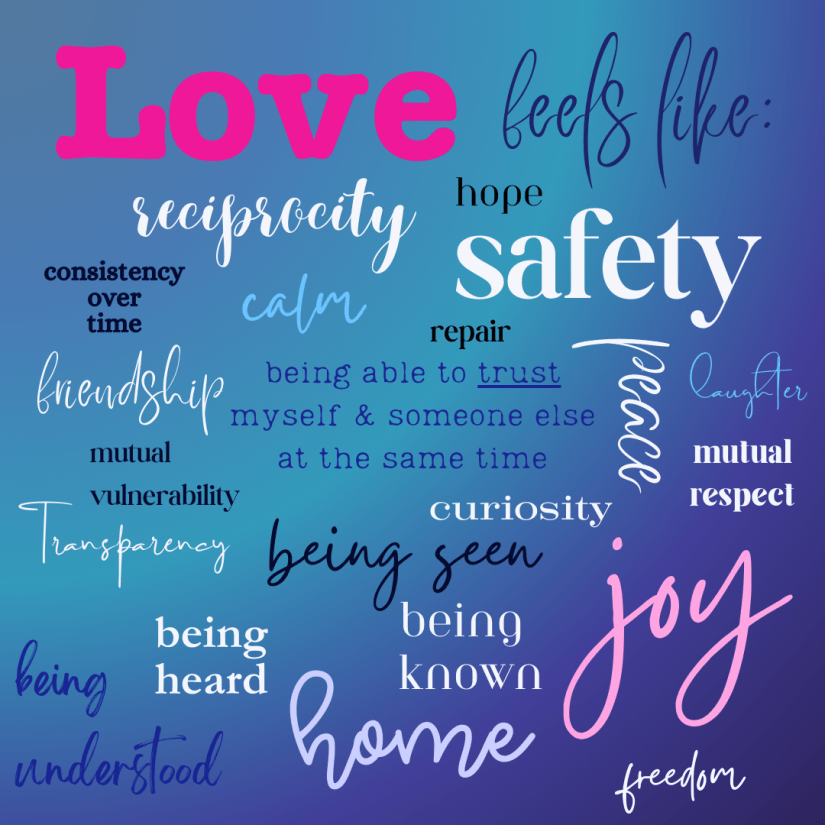
At its root, feeling loved is about feeling safe to be seen, heard, understood, known, and accepted as the whole complex human you are—body, mind, and soul.
I had the privilege of sharing sacred space with a stranger at church a few weeks ago. He’d never been to our church before and I found him sitting at a table in our worship space drinking a cup of coffee during the Sunday School hour while the Worship band rehearsed. I sat down next to him, offered him my hand, and asked his name. Through tears, he told me his name and began to share his story. He was heartbroken and grieving. He needed someone to give witness to his pain. He needed someone to hear his story. He needed someone to listen, to see him, and to believe him. There was nothing anyone could do to fix his situation—he knew that.
That’s the thing about grief— it is particularly gut-wrenching because of the finality of the experience and the loss of hope that comes with it. Of course, as Christians and many other people of faith, we believe in a different kind of hope, but the hope that this specific situation can have a different outcome is gone, because of the finality of the grief-inducing event. Whether it be the death of a loved one, a friendship, a job, a business dream, a physical space we’re connected to through relocation, or the many other losses we experience throughout our lifetime, part of that loss is the loss of hope that we had in this future story looking different than it is now.
At one point during our conversation, he was sharing about his decision to come to church and he made the comment “I feel safe here.” For so many reasons, I can’t stop thinking about that statement.
“I feel safe here.”
As a single woman, divorce has been a master class in learning what love and safety feels like for me—starting with how I embody that love and safety for myself. That’s where so much of my rootwork exists—excavating my roots for all the distrust of self and others, shame and trauma, and feelings of being both too much and not enough at the same time; holding safe space for all of who I am as a beautiful human without apology; making reparations with myself for the ways I have betrayed myself—physically, emotionally, mentally, relationally, vocationally, spiritually; and learning to recognize the people and spaces outside of myself where I am safe to exist and grow and make mistakes and experience repair. In that uprooting and excavation, I am creating safety to honor and embrace all of who I am—deeply rooted and grounded in self-love, so that I can recognize what safety and love feels like in relationship with others.
Creating love and safety with and for myself are at the root of co-creating that safety and love everywhere else—whether as parent, friend, healer, daughter, sister, romantic partner or human in community. It has meant learning what my boundaries are and how to own my responsibility as keeper of my boundaries; discernment when I feel “triggered” or “unsafe” to explore, identify, and acknowledge when that feeling is rooted in my own trauma response or a boundary violation and then having the courage to communicate that, either way. When we struggle with trusting ourselves and others, that discernment can be hard. When we feel scared and hurt, it can be hard to know what our emotions are telling us and whether we can trust our own interpretation of those feelings, let alone trust that the person we are sharing them with is willing and capable of holding up a mirror for us to work through them without making us feel responsible for their emotions too.
As a parent who believes in an attachment style of parenting, that is my primary goal—that whatever else my role as a parent is, at its core, my job is to create safety for my children to engage the world, process information, feel all of their feelings, wonder, have opinions—to discover who they are and celebrate everything that means. They can’t do that if they are constantly having to filter their truth through the emotions of other people—they have to feel safe to have their own unique experiences, feelings, thoughts, opinions, and truths without judgment or concern for another person’s emotional response. As a parent, our responsibility for creating safety is comprehensive.
Physical safety includes ensuring their basic physical needs are maintained—shelter, food, clean water, protective clothing, hair care and basic hygiene, and access to appropriate medical care.
Mental safety includes ensuring they have access to education and are supported in their learning.
Emotional safety means they feel safe to feel all of their feelings and are equipped with tools to express and manage those emotions in healthy ways. In our house this means we communicate with respect and dignity and when we fail to do that, we make repairs; they know they can tell me anything; they are never responsible for my emotions—even if it hurts to hear, I would always rather know their truth because their truth is valid and it matters; mistakes happen; repair is ALWAYS possible when we partner recognition of wrongdoing with behavior change; and that I am responsible for teaching them what repair looks like through my own willingness to be held accountable, grow, and make changes in my behavior.
Creating safety, as a parent, also looks like building a community around them that is safe, where they are free to be fully human—where they can learn and grow from individuals and communities outside of me—fostering nurturing relationships with our extended families, church community, friends, their amazing school community, and access to a counselor without me being a keeper of their story, experience, or truth.
As a healer, my work looks like holding space for others to learn how to be present with their body while they learn to feel their emotions and know they are safe at the same time. So often, our body and our mind respond to our emotions of grief the same way they respond to trauma—because at its inception, our grief is caused by an event that we experience as traumatic. No matter how mentally or emotionally prepared we believe ourselves to be for a loss, we cannot fully comprehend the fullness of what the lived experience will feel like. So when the “bad thing” happens, our body reacts, our stress hormones are released and our natural instincts of self-preservation are set into motion. Throughout the grief process, when our mind remembers this bad thing has happened, and we experience those same feelings, oftentimes those natural physical responses are triggered.
So part of the work of healing is teaching our body and our mind that the bad thing has already happened.
We are not currently in danger.
We don’t need to respond with those fight, flight, freeze, fawn responses.
There is nothing for us to do.
We are safe to feel the feelings and honor our loss with our grief—learning how to transform all the love we had for the object of our grief into ourselves and honoring the memory of that loss.
As a human, feeling safety and love should be a non-negotiable—and yet, we know this is not the case. For a million different reasons, the experience of love does not always feel like safety. For a million different reasons, many have learned that love is not safe and so the ways that we relate to others doesn’t create safety.
This means we miss opportunities for connection.
We miss opportunities to truly see the humanity in a stranger.
We miss opportunities to be mutually heard and understood.
We miss opportunities for intimacy.
We miss opportunities to grow.
We miss opportunities for the very thing we were created—to be fully who we were created to be in relationship with other humans who are fully who they were created to be—beloveds created in the image of the Divine in relationship.
We miss opportunities to see and be seen fully…
…to hear and be heard fully
…to know and be known fully
…to love and be loved fully.
I don’t know about you, but that isn’t enough for me. That is not enough for me as a human, as a mother, as a friend, as a daughter, as a sister, as an aunt, as a partner, as a healer, as a person living in community…
I don’t want to settle for surface-level existence, or relationship, or community, or faith, or work. I don’t want to let my discomfort prevent me from growth and intimacy and connection and love. I want depth.
I want to be beloved and in relationship with others who know they are beloved.
I want to be home for myself and for those I encounter.
I want to be safe for myself and for those I journey with.
I want to be love and be loved!

 Uprooted